Christmas Eve, Year A, December 24, 2025
What I have learned in these past few years
of living in Atlanta
is that the traffic is really not as bad
as it is usually made out to be.
It is the driving that is terrible.
Nearly every trip I make
feels like some kind of road hazard simulation,
wherein the objective is to arrive at your destination
alive, the car in one piece, on time,
and in obedience to the law.
Often, I am forced to sacrifice
at least one of these objectives
to get where I am going
and home again.
Since I arrived here alive,
in an intact vehicle,
and on time,
I’ll let you guess which objective
I most often sacrifice.
This seeming simulation is not gridlock,
all of us stuck on the freeway,
inching along,
hour by hour.
It is more like an obstacle course
of pedestrians, racecars,
school busses,
debris from accidents,
roadkill from armadillos to contorted deer,
out of state tags,
and distracted drivers.
Almost every day,
I have to maneuver around someone
going 12 miles below the speed limit,
and as I pass,
I can see the tell-tale chin to chest posture
of someone looking at their phone.
Or they’re navigating the GPS
on their mounted device.
I have seen folks putting on makeup
at 32 mph in the left lane.
Once on 285,
I saw a man reading a full-size newspaper
with both hands
in a car that I am almost certain does not have
a self-driving feature.
I’ve seen folks eating entire meals,
vaping mushroom clouds out the driver’s window,
changing shirts,
holding a lapful of small dogs—
or children—
and I’m sure each of you could add to this list
of circus tricks.
Father Richard Rohr says that how we do anything
is how we do everything.
That is,
if we take just a moment to consider
our driving,
we can see that we are driving
like we are living our whole lives—
distracted, in a hurry, anxious,
and dangerously inconsiderate.
We are all in a hurry,
and none of us are used to
doing one thing at a time.
We have been conditioned by our culture,
by our employers,
by social media videos of life hacks,
to believe that we should be maximally efficient,
that we should be able to walk and chew gum
and do calculus in our heads, all at the same time.
All of the preparations leading up to this holiday
only add to a never-ending list of responsibilities,
expectations, deadlines, and outcomes
we have to meet.
It’s no wonder we can’t drive undistracted.
And it’s no wonder
that we are so resistant
to the idea of prayer.
Who has time?
Who can be still?
Even if I sit still,
my mind is racing,
filled with to-do lists and disquiet,
with memories of that time
when the guy in the drive thru said,
“Come again!”
and you said, “You too!”
You can’t stop feeling kind of offended
when that lady at work saw your new shirt
and said, “What a unique color.”
What’s that supposed to mean?
You can’t stop feeling
the mixture of anger and sadness
that only grief can bring.
We think of prayer, contemplation,
mindfulness,
as something beyond us,
something for monks and mystics
not parents and people with day jobs.
Multitasking is the opposite of contemplation.
But I think it is also the beginning.
Near the end of our gospel reading
is a curious phrase.
“Mary treasured all these words
and pondered them in her heart.”
Now, Mary,
while traveling,
has just given birth
in a barn,
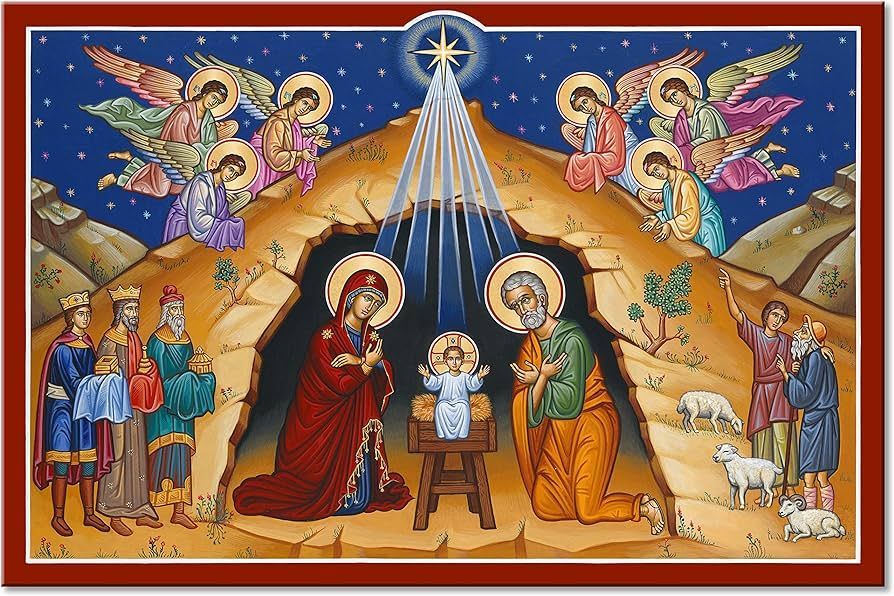
with a feeding trough for a crib.
She’s been visited by a band of uninvited—
and likely unwashed—
shepherds who were directed to this barn
by a company of the heavenly host.
Road-weary and child-birth exhausted Mary
receives the shepherds’ story,
treasuring and pondering it
“in her heart.”
There is another form of contemplation,
meditation, prayer,
for us working stiffs
that we aren’t often taught.
Mary is the mother of an infant.
Do you really think she has the time
for a 20-minute meditation practice
twice per day?
No.
Nor could most of us
carve out such time in our busy days
to sit silently and meditate.
But Mary can be our model
for a new kind of prayer.
************************
St. Julian of Norwich
is often depicted with a hazelnut
in one hand.
St. Julian saw a truth about the whole universe
contained in this tiny hazelnut.
She wrote,
“In this little thing I saw three properties.
The first is that God made it.
The second that God loves it.
And the third, that God keeps it.”
In the focused attention of St. Julian
she became aware of a truth beneath,
behind, and beyond the hazelnut,
namely that God made, loves, and holds together
the whole universe.
This is the same truth proclaimed to Mary
by angels and shepherds
which she treasured
and pondered in her heart.
But instead of a hazelnut,
she had this baby,
wrapped in bands of cloth
and lying in a manger.
When we are multitasking
like a one-man band
we cannot focus our attention
on just one thing.
But if we can focus on just one thing
we too might find the love of God
hidden beneath, behind, and beyond this one thing.
We, like Mary,
are given this baby to focus our attention
this Christmas.
We are given this hour,
this worship service,
to treasure these words
and ponder them in our hearts.
We are given this bit of bread
and this sip of wine
that focusing our attention
on Body and Blood of Jesus
we too might find that we are
made by God, loved by God, and kept by God,
just like everything else in the universe.
Tonight, tomorrow,
and over the days to come,
from time to time,
take just a moment
to focus your attention
on the thing at hand,
your work in the moment.
As you pack away your decorations,
maybe this year,
keep out the manger and the baby Jesus.
Let this baby be a reminder
to focus your attention in the moment.
Over time, you will begin to see
as Mary and St. Julian saw,
the love of God hidden beneath, behind, and beyond
this moment, this work, this object.
This seeing will transform your whole life.
And it might even make you
a better driver.
Amen.